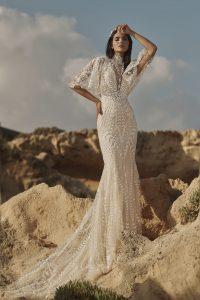
Every detail of a bridal gown tells a story about its designer, about marriage and wedding ceremonies, and with the help of adjustments and modifications about the bride herself.
Some of our favourite conversation starters come from our Rue De Seine collection, replete with immaculate embroidery, striking colour contrasts and an unapologetic use of striking floral and lunar imagery based heavily on Art Nouveau aesthetics.
Whilst beauty is a good enough reason to incorporate any type of design, it is remarkably fitting and unique to incorporate Art Nouveau elements into a white bridal gown, because both styles began to capture the imagination of brides at roughly the same time.
The first white wedding in the way we understand it was in 1840 when Queen Victoria married Prince Albert in a highly publicised and influential ceremony, but it was not until the end of the 19th century and the start of the 20th century that the white wedding dress became available to women who were not similarly absurdly wealthy.
By this time, it was an absolutely perfect companion for the Art Nouveau movement and its pure devotion and love of natural forms and features.
Art Nouveau is the opposite of the more commonly known Art Deco style, which was far more openly industrial and often focused on practical symmetry.
Instead, Art Nouveau was focused on celebrating the beauty of the asymmetrical; it was optimistic, filled with floral motifs, bright colours, and often shimmering, swooping linework made possible through metallic threaded embroidery.
Whilst the dawn of the white wedding was nearly a century before this, the popularity of a white wedding and the emphasis on floral arches, bouquets, veils and necklaces with striking designs and set gemstones emerged from around the same time.
Unfortunately, the peak of the style would last less than a generation. However, its legacy has been sustained ever since by its influences on the wedding ceremonies and bridal dresses we know and love today.